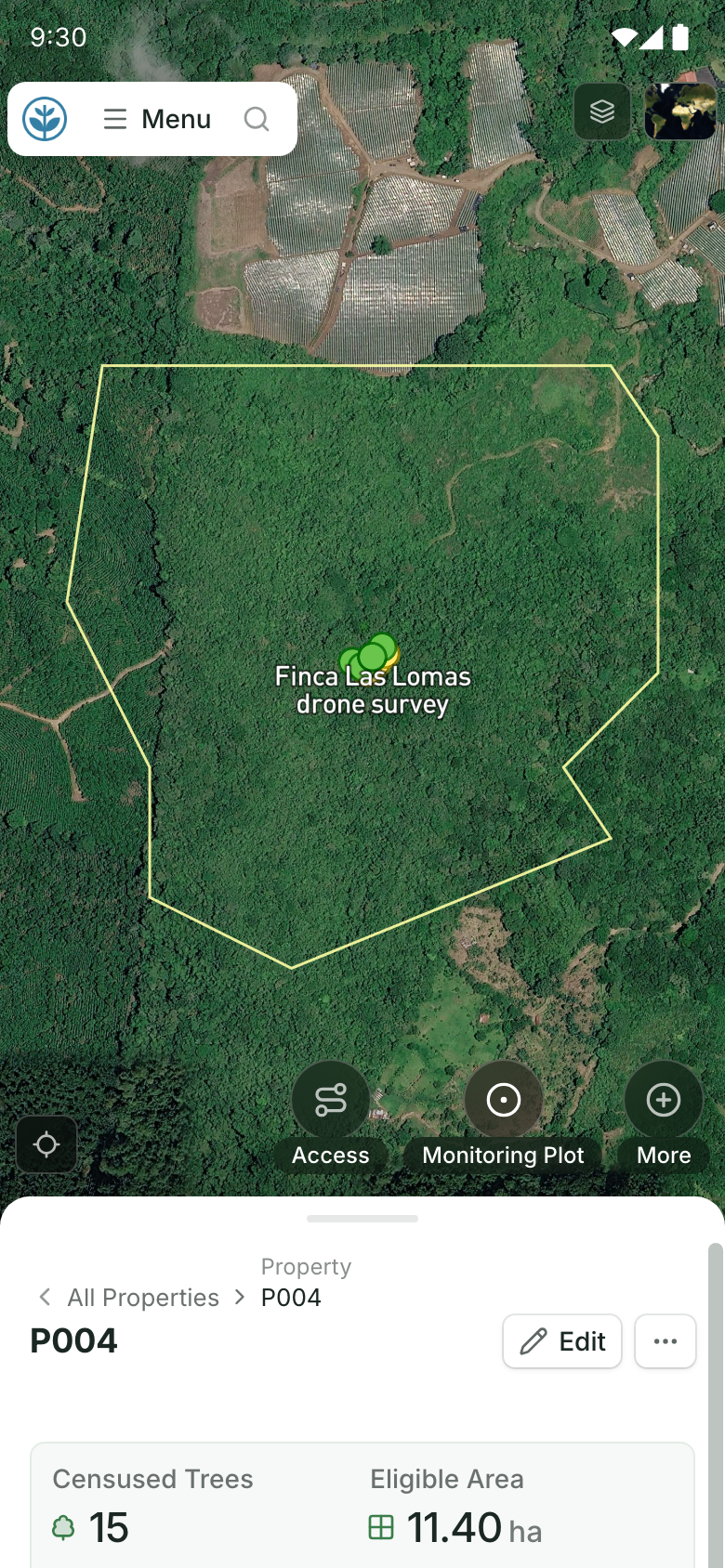
Boundaries saved to their site
A boundary drawn or walked in the Field App is saved to the site it belongs to, with its area.
ODK is open-source data collection used worldwide, with polygon capture and offline maps. Restoration Scope starts where the form ends: it ties records to sites over time and shows them to the people who need them.
 Restoration Scope
It depends on who builds and maintains the system. ODK suits a team that wants open source end to end, may host its own server, and has someone who writes XLSForm and designs the data model. Restoration Scope suits a team that wants forms, sites, maps and reports in one place without building those links, with coordinators and funders who need to see the work rather than export files. ODK forms can keep running while their records join the project.
 ODK | Restoration Scope | |
|---|---|---|
| What it is | Open-source forms, a mobile app and a server, from Get ODK Inc. | A restoration data platform: a configured field app, linked records, maps and portals. |
| Cost | As of October 2026: free to host yourself. ODK Cloud is $199 a month (Standard) or $499 (Professional) billed yearly, or $249 and $599 billed monthly. Enterprise is custom. | Priced per project after a scoping call. No public price list. |
| Setup | Forms written in XLSForm. You run the server or rent ODK Cloud. | Configured with our team around your project. Someone on your side owns the workflow. |
| Offline capture | Works offline and syncs once it finds a connection, with offline background maps. | The Field App works offline: points, lines, polygons and photos. |
| Shapes and area | Point, line and polygon questions. Walking a boundary records it, and the form can calculate its area. | Points, lines and polygons drawn or walked on the project map, saved to the site they belong to. |
| Knows your project | Entities let forms share lists such as sites or trees between submissions (Professional plan and above on ODK Cloud, or self-hosted). You design and maintain that data model. | Sites, nurseries, species and visits are linked records, configured for your project with our team. |
| Donor reporting | Dashboards on ODK Cloud, plus exports to Excel, Power BI, R or Python for reports. | Donor portals built from the same records the team keeps. |
ODKODK forms keep running in the field.Restoration ScopeSubmissions map to project fields and join their sites.Restoration ScopeThe project map and donor portals show them.Restoration Scope maps submissions from existing survey tools to project fields, so ODK forms can keep running while their records join the rest of the project.
Checked against ODK's own pages on October 17, 2026: ODK home and pricing, Getting started, Question types, ODK Collect, Offline maps, ODK and Kobo.
These are Restoration Scope screens from our demo project and a public donor portal. To see ODK, visit its own site.
A boundary drawn or walked in the Field App is saved to the site it belongs to, with its area.

Sites, plots and visits link to each other, so a site shows everything recorded about it.
ODK collects forms and works as one part of a network of tools, beside a spreadsheet and a GIS. Restoration Scope is an adaptable platform where field data, sites and maps share one record.
Where restoration records live, from word of mouth to custom softwareFor flexible survey forms, no: ODK is open source, proven and free to host yourself. Restoration Scope replaces what teams build after the form: linking records to sites, maps and reports.
The software is free and open source if you host it yourself. As of October 2026, ODK Cloud, the hosted service, starts at $199 a month billed yearly, or $249 billed monthly.
They are close relatives: KoboCollect is built from ODK Collect and both read XLSForm. Kobo offers free hosting for nonprofits; ODK can be self-hosted or rented as ODK Cloud.
Yes. We map submissions from survey tools to project fields, and spreadsheet or GIS exports can come in as files.
Restoration Scope publishes this comparison. Something out of date? Write to info@restorationscope.com.
Bring in the spreadsheets, field forms and maps you already use, and see every site in one place.